
This is a plain-language guide for HR leaders, hiring managers, and startup founders who want to understand what AI actually adds to an ATS and what is left behind when it is missing.
Most companies using an applicant tracking system today are using the same kind of software they were using a decade ago. It stores CVs. It moves candidates through stages. It sends the occasional automated rejection email. And it leaves almost everything that actually determines hiring quality entirely in the hands of overloaded recruiters.
That is the gap that AI-powered applicant tracking is closing. In 2026, organisations that have made the shift will measure the gap between themselves and those still running legacy ATS workflows in terms of time-to-hire, quality-to- hire, recruiter burnout, and competitive advantage in the talent market.
This blog explains what an AI ATS actually is, how it is different from the traditional version, what it does that your current system cannot, and why platforms like easemyhiring.ai represent the next generation of how smart hiring teams manage their pipelines.
What is a traditional ATS, and what does it actually do?
An applicant tracking system, in its traditional form, is essentially a database with a workflow layer on top. Candidates apply, their information is stored, and a recruiter moves them manually through stages: applied, screened, interviewed, offered, hired, or rejected.
The core functions of a traditional ATS are fairly straightforward:
- Collecting and storing application data from job boards and career pages.
- Parsing CVs and extracting basic information like name, education, and work history.
- Allowing recruiters to organise candidates into pipeline stages.
- Sending templated communications at certain trigger points.
- Generating basic reports on pipeline volume and stage progression.
For its time, this software was a significant improvement over spreadsheets and email folders. But the critical limitation of traditional ATS is that it stores and organises information. It does not evaluate, assess, or act on it. Every intelligent decision still requires a human to make it manually.
That is where the bottleneck lives. And that is what AI is designed to remove.
A traditional ATS is a filing cabinet with a workflow attached. An AI ATS is a hiring co-pilot that evaluates, screens, interviews, and reports so your team only has to decide.
"What is an AI Applicant Tracking System?
An AI applicant tracking system uses artificial intelligence in the main steps of hiring, taking over slow manual tasks with smart automated processes that can work at any size without needing people to manage them.
The key distinction is not just automation. Basic ATSs already automate some things, like sending a confirmation email when someone applies. The distinction is intelligence applied at the evaluation layer, the part of hiring that has always required a human recruiter’s time and judgement.
Here is what an AI ATS actually does that a traditional one cannot:
Intelligent screening beyond keyword matching
Traditional ATS screening works by matching keywords in a CV against a list of required terms. If the CV contains the words, it passes. If it does not, it fails. The problem is that this approach is both too blunt and too playable. Qualified candidates who describe their experience in different languages get filtered out. Unqualified candidates who know the right keywords get through.
AI-powered screening understands context and meaning, not just surface-level word matches. It evaluates whether a candidate’s experience and stated competencies align with what the role requires, at a level of nuance that keyword parsing never reaches.
Automated, structured first-round interviews
This is the single most significant capability gap between a traditional ATS and an AI-powered one. A traditional ATS can schedule a human interview. An AI ATS can conduct the interview itself.
Platforms like easemyhiring.ai run structured, role-specific AI interviews for every candidate in the pipeline. The AI asks consistent, pre-defined questions, evaluates responses against the same competency criteria for every candidate, and generates an instant performance report the moment the interview ends. No recruiter time. No scheduling coordination. No variation between candidates.
For organisations handling large volumes of applications, this capability alone can save recruiters weeks per hiring cycle.
Automated candidate communications and reminders
A traditional ATS sends templated emails at pre-set trigger points. AI ATS manages the entire communication flow intelligently, including sending personalised interview reminders, handling rescheduling requests, and maintaining candidate engagement throughout the pipeline without any manual intervention.
Easemyhiring.ai automatically sends timely reminders to every candidate in the interview pipeline, eliminating no-shows and the manual follow-up that consumes enormous recruiter time during active hiring periods.
Instant, objective performance reports
After every AI-conducted interview, an AI ATS generates a structured performance report automatically. Your hiring managers receive objective, data-backed scoring for each candidate the moment their interview is complete, rather than waiting for a recruiter to compile notes, schedule a debrief, and summarise findings.
This shifts the hiring manager’s role from receiving a verbal briefing based on someone’s memory to reviewing a structured dataset that is consistent, comparable, and available immediately.
Bias-reduced evaluation at scale
Every human-led screening and interview process carries unconscious bias. It is not a question of intent. It is a function of how human cognition works under time pressure and volume. AI evaluation applies the same criteria to every candidate in the same way, regardless of name, background, or how the recruiter’s day is going.
For organisations committed to diversity and fair hiring, this feature is not nice to have. It is a structural improvement that reduces one of the most consistent sources of hiring error.
Traditional ATS vs AI ATS: The full comparison
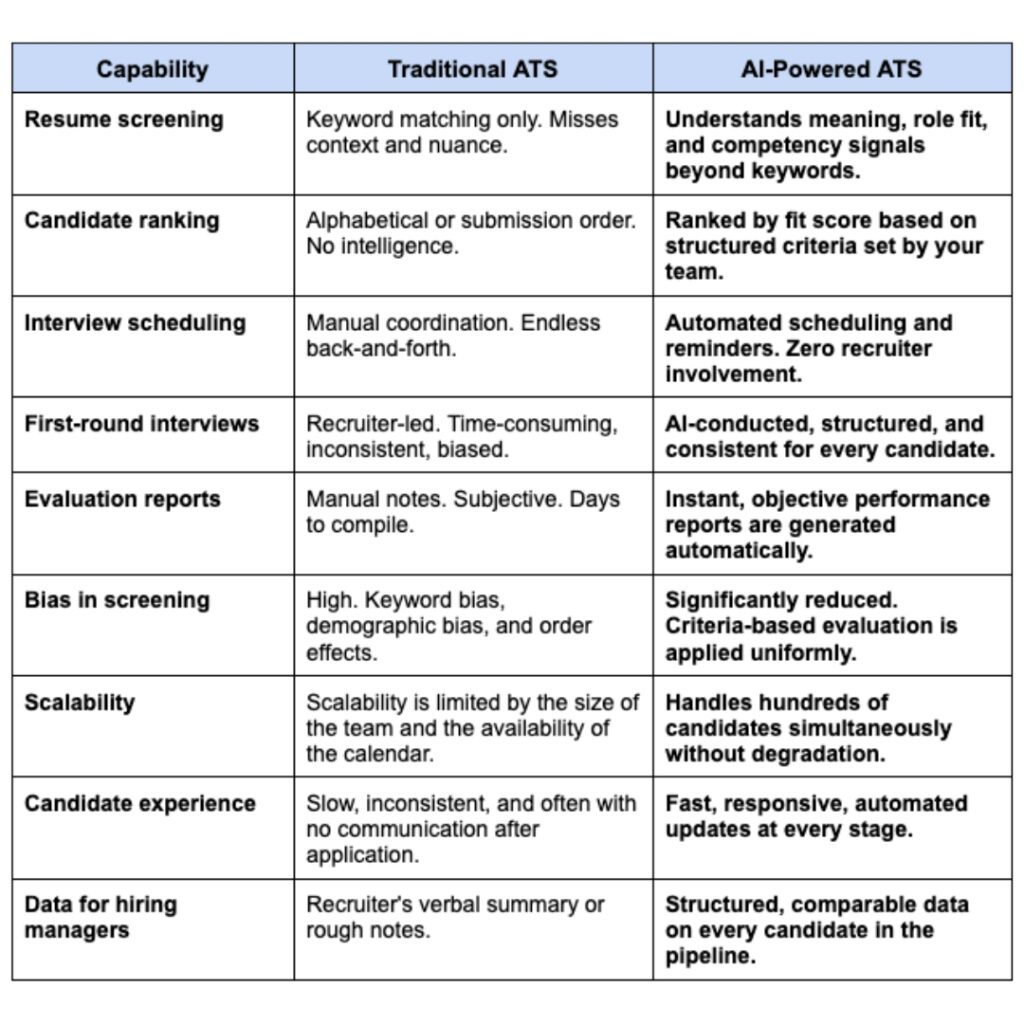
Comparison based on standard ATS capabilities vs AI-powered recruitment platforms, including easemyhiring.ai.
"Why is your current ATS leaving value on the table?
If you are currently using a traditional ATS, you are probably experiencing at least some of the following:
- 75% of recruiters say their ATS makes it harder, not easier, to find qualified candidates. (LinkedIn Talent Trends)
- 52% of talent acquisition leaders say their biggest challenge is identifying the right candidates from a large applicant pool. (SHRM)
- 4 hrs average recruiter time spent per candidate on manual screening, scheduling, and reporting — before a single interview happens.
The core problem is that traditional ATSs are optimised for storing and organising candidate data. It does not optimise the process of finding and evaluating the right candidates. Recruiters, already stretched, manually fill that gap, using judgement that is inherently inconsistent at scale.
Every hour your recruiters spend on screening, scheduling, reminding, and reporting is an hour they are not spending on the strategic work that actually requires human intelligence: building relationships with top candidates, engaging hiring managers, and designing the hiring experience that makes outstanding people keen to join your company.
Who needs an AI ATS the most?
Startup founders building fast
When you are a founder wearing ten hats and trying to grow a team quickly, you do not have the recruiter bandwidth to run a thorough manual hiring process for every role. An AI ATS gives you an enterprise-grade screening and interview process without the enterprise-grade headcount to run it.
With easemyhiring.ai, a founder or a two-person HR team can run structured, consistent, data-backed screening for every applicant without manually reviewing a single CV or conducting a single first-round call.
Hiring managers with multiple open roles
When you have five to ten roles open simultaneously, and a recruiter team that cannot keep up with the volume, the quality of screening inevitably drops. Roles stay open longer. The rushed process allows undesirable hires to slip through undetected.
An AI ATS removes the volume bottleneck entirely. Every candidate gets properly evaluated. The shortlist your hiring managers receive is genuinely qualified, not just the candidates who happened to get the most attention from a stretched recruiter.
Companies running bulk or campus hiring
For organisations that regularly hire at high volumes, whether for graduate intakes, seasonal recruiting, or large-scale expansions, a traditional ATS is fundamentally unfit for purpose. The manual evaluation workload simply does not scale.
easemyhiring.ai handles hundreds of AI interviews simultaneously, each generating an instant performance report. The workload on your HR team does not increase with volume. From the first candidate to the last, the evaluation’s quality remains the same.
What to look for in an AI ATS in 2026
Not every platform that claims to be AI-powered delivers genuine intelligence at the evaluation layer. Here are the capabilities that actually matter when you’re evaluating AI ATS for your organization:
- AI-conducted interviews, not just AI-assisted scheduling. The platform should be able to run the first-round interview itself, not just help a human schedule one.
- Structured, role-specific question frameworks. Every interview should be built around the specific competencies required for the role, not generic questions applied across all positions.
- Instant, objective performance reports. Reports should be generated automatically the moment an interview ends, with consistent scoring criteria applied to every candidate.
- Automated reminders and candidate communications. The platform should handle all follow-ups without any manual recruiter involvement.
- Bias-reduced evaluation framework. The screening and evaluation model should be designed to reduce, not replicate, the bias patterns common in human-led processes.
- Scalability without quality degradation. The system should perform identically whether you are evaluating ten candidates or ten thousand.
How does easemyhiring.ai fit into your existing workflow?
HR teams frequently ask whether AI recruiting platforms replace their existing ATS or integrate alongside it.
easemyhiring.ai is designed to function as the intelligent screening and interview layer that sits between your application intake and your human evaluation stages. It picks up where a traditional ATS’s capabilities end, handling the first-round assessment and reporting that manual processes have always struggled to do consistently at scale.
Your team continues to own the final rounds, the offer process, and the relationship layer of hiring. easemyhiring.ai handles the volume, the consistency, the reminders, and the reporting that was always the most time-consuming and least strategic part of the process.
The result is a hiring pipeline where your recruiter’s intelligence is applied, where it actually makes a difference, and the parts that do not need human judgement are handled automatically, at any scale, with complete consistency.
The bottom line
A traditional ATS was built for a world where hiring volume was manageable, recruiter time was plentiful, and the cost of inconsistency was acceptable. None of those conditions would describe most organisations in 2026.
An AI applicant tracking system is not an upgrade on the same concept. It is a fundamentally different approach to how a hiring pipeline works, one where the evaluation, the interviews, the reminders, and the reporting are handled intelligently and automatically, so your team can focus on the decisions that actually require human judgement.
Currently, the companies winning the talent competition are not the ones with the largest HR teams. They are the ones with the smartest processes. Those processes rely on platforms like easemyhiring.ai.
Your ATS stores candidates. It is time for a system that actually finds the best ones.
If your current ATS leaves the hardest, most time-consuming parts of hiring entirely to your team, it is not working as hard as it should. Here is what changes when you bring easemyhiring.ai into your hiring pipeline:
- AI-conducted, structured first-round interviews for every candidate. No recruiter time. No scheduling coordination. No inconsistency.
- Instant, objective performance reports for every interview completed. Your hiring managers get data, not a verbal debrief.
- Automated reminders that eliminate no-shows and manual follow-up entirely. Your team stops chasing and starts deciding.
- Bias-reduced evaluation is applied consistently at any volume. From ten candidates to ten thousand, every applicant gets the same fair assessment.
- A hiring pipeline that scales without increasing your headcount. Built for startup founders, hiring managers, and bulk hiring teams who need to move fast without cutting corners.
Book your free consultation at easemyhiring.ai and see what a hiring pipeline built for 2026 actually looks like.
Your next great hire is already in your pipeline. The question is whether your ATS is smart enough to find them.
"