

Why is the job description often the most underestimated part of hiring, and how is AI addressing the issues that have quietly cost you your best candidates?
Every hiring process starts with a job description. And for most companies, that job description is written in one of two ways. Either a recruiter opens a blank document and starts typing from memory, pulling from whatever they can recall about the role. Or someone finds the last version, changes the date, updates a few bullet points, and sends it out.
Neither approach is serving you well. The data shows that poorly written job descriptions significantly damage application quality, time-to-hire, and the calibre of candidates who actually show up, more than most hiring teams realise.
In 2026, AI-powered job description generation is changing the way job descriptions are created from the ground up. What used to take 45 minutes of careful writing, a review cycle, and a revision, and still ended up inconsistent, biased in ways nobody noticed, and keyword-blind, now takes under 60 seconds to produce a structured, consistent, bias-reviewed draft that is ready to post.
Here is what is actually happening under the hood, why it matters for your hiring outcomes, and how platforms like easemyhiring.ai are connecting better job descriptions directly to better candidates in the pipeline.
Why do job descriptions matter more than most teams think?
The job description is the first filter in your entire hiring funnel. Candidates read the job description before they apply, speak to a recruiter, or review your interview questions. And they make a decision based on it.
The quality of that decision determines everything that comes after, including whether the right people apply and the wrong people self-select out. A bad job description does not just waste candidate time. It wastes your team’s time on applications from people who were never going to be a fit while simultaneously turning away qualified candidates who read the description and decided the role was not for them.
- 72% of hiring managers say poorly written JDs are a top reason for unqualified applicants. (LinkedIn Talent Solutions, 2025)
- 60% of candidates say a confusing or off-putting job description causes them to abandon an application mid-way. (Indeed Hiring Lab, 2025)
- 42 mins average time a recruiter spends manually writing a single job description from scratch. (SHRM Recruiting Data, 2024)
- 36% more applications received by companies that use inclusive, clearly structured job descriptions vs generic ones. (Textio Research, 2024
Put those numbers together, and the picture is uncomfortable. Most job descriptions are written in a way that filters out good candidates, encourages bad ones, takes nearly an hour of recruiter time per role, and produces inconsistent output that reflects whoever happened to write it that day rather than a coherent company standard.
The job description is not a formality at the start of the hiring process. It is the first and most important screening tool you have. If it is poorly written, everything that follows is harder and less accurate than it needs to be.
The real problems with manually written job descriptions
Before getting into what AI does differently, it is worth being specific about what manual JD writing gets wrong most consistently. These are not edge cases. They are patterns that show up across most organisations, regardless of size or sector.
Over-specified requirements shrink the applicant pool unnecessarily
The most common pattern in manually written job descriptions is requirement inflation. A role that genuinely needs three years of relevant experience gets listed with five to seven. A position that works perfectly well with a degree from any discipline ends up specifying a particular field that has no real bearing on performance. A job that involves occasional data analysis gets listed with advanced SQL as a mandatory requirement.
This happens because the person writing the JD is either copying from a previous version that was already overspecified or listing aspirational requirements rather than minimum ones. The result is a significantly smaller applicant pool, a demographically narrower one, and no improvement in the quality of candidates who get through.
Research from LinkedIn consistently shows that women are significantly less likely than men to apply for a role unless they meet nearly all of the listed requirements. Over-specified JDs do not just reduce your pipeline. They make it less diverse in ways that have nothing to do with actual job requirements.
Gendered and exclusionary language goes unnoticed
Language bias in job descriptions is well-documented and widely ignored. Words like ‘rockstar’, ‘ninja’, ‘dominant’, and ‘competitive’ attract male applicants at statistically higher rates. Phrases like ‘fast-paced environment’, ‘work hard play hard’, and ‘must be able to handle pressure’ can signal an exclusionary culture to candidates from underrepresented groups. Even something as simple as the ratio of must-have requirements to soft-skill language shifts the demographic profile of who applies.
The person writing the JD rarely notices this. They are not trying to exclude anyone. They are writing from habit, copying from existing templates, and using language that sounds normal to them. Without an active bias-detection layer, the problem is invisible and self-perpetuating.
Generic descriptions attract generic applicants
When a job description reads like a generic list of duties that could apply to any company in the industry, it attracts candidates who are spraying applications rather than being genuinely motivated by the specific opportunity. The strongest candidates, who are most selective about where they apply, will pass on a JD that gives them no real sense of what the role, the team, or the company is actually like.
A description copied from a template and updated with minimal changes wastes the opportunity to make a great candidate feel genuinely interested in your role before they even apply.
Keyword gaps hurt your visibility on job platforms
Job boards like LinkedIn, Naukri, Indeed, and Shine rank job listings in search results based on relevance to what candidates are searching for. A job description that uses internal company language or outdated terminology for a role will rank lower in search results than one written with the terms candidates actually type into the search bar.
Manually written JDs are rarely optimised for how candidates search. They use the company’s internal job title vocabulary, not the market vocabulary. They describe responsibilities in ways that make sense internally but do not match what a candidate searching for a similar role would type. The result is lower visibility, fewer applications, and a longer time-to-fill for no good reason.
Manually written job descriptions are not just inefficient. They are actively working against you in ways most hiring teams are not measuring: inflated requirements turning away qualified candidates, biased language narrowing your demographic pool, generic content driving away your best applicants, and keyword gaps making your roles invisible in search. All of this happens before a single candidate clicks apply.
What does AI job description generation actually do?
AI-powered JD generation is not a spell checker or a formatting tool. When it works properly, it is a trained language model that understands role context, job market language, inclusive hiring standards, and what makes a description compelling to a candidate, rather than just what makes it complete to a recruiter.
Here is what the AI does at each stage of the process:
It starts from the role context, not a blank page
A good AI JD tool does not require you to write a first draft and then improve it. You provide the role title, seniority level, key responsibilities, and any specific requirements. The AI generates a complete, structured draft from those inputs in seconds. The recruiter’s job becomes reviewing and refining rather than writing from scratch, which is a fundamentally different and far more efficient use of their time.
It writes to attract, not just to inform
The best AI-generated job descriptions are trained to write in a way that makes the role genuinely appealing to the target candidate, not just accurate about its requirements. The language is active, the responsibilities are outcome-focused, and the opportunity emphasises what the candidate gains from the role rather than just what they owe the company.
This is the difference between a compliance document that lists duties and a talent attraction asset that makes a qualified candidate think this is the right next step for me.
It calibrates requirements to what the role actually needs
A well-trained AI model understands the relationship between role type, seniority level, and realistic requirements. It knows that a mid-level marketing manager role does not genuinely require ten years of experience. It flags when requirements have been inflated beyond what the role reasonably demands and suggests calibrated alternatives that attract a broader, more qualified pool without lowering the actual standard.
It detects and removes biased language automatically
Bias-aware AI models are trained to identify gendered, age-coded, and culturally exclusionary language and suggest replacements that maintain the intended meaning while broadening applicant appeal. This happens automatically in the generation process rather than requiring a separate manual review step that most teams either do poorly or skip entirely.
It optimises for how candidates actually search
AI models trained on job market data understand the gap between how companies describe roles internally and how candidates search for them externally. A company might call a role a Growth Specialist. Candidates search for ‘Digital Marketing Manager’ or ‘Performance Marketing Executive’. An AI-generated JD bridges this gap by using the language the market actually uses, which directly improves search visibility and application volume on job boards.
What a great AI-generated job description includes:
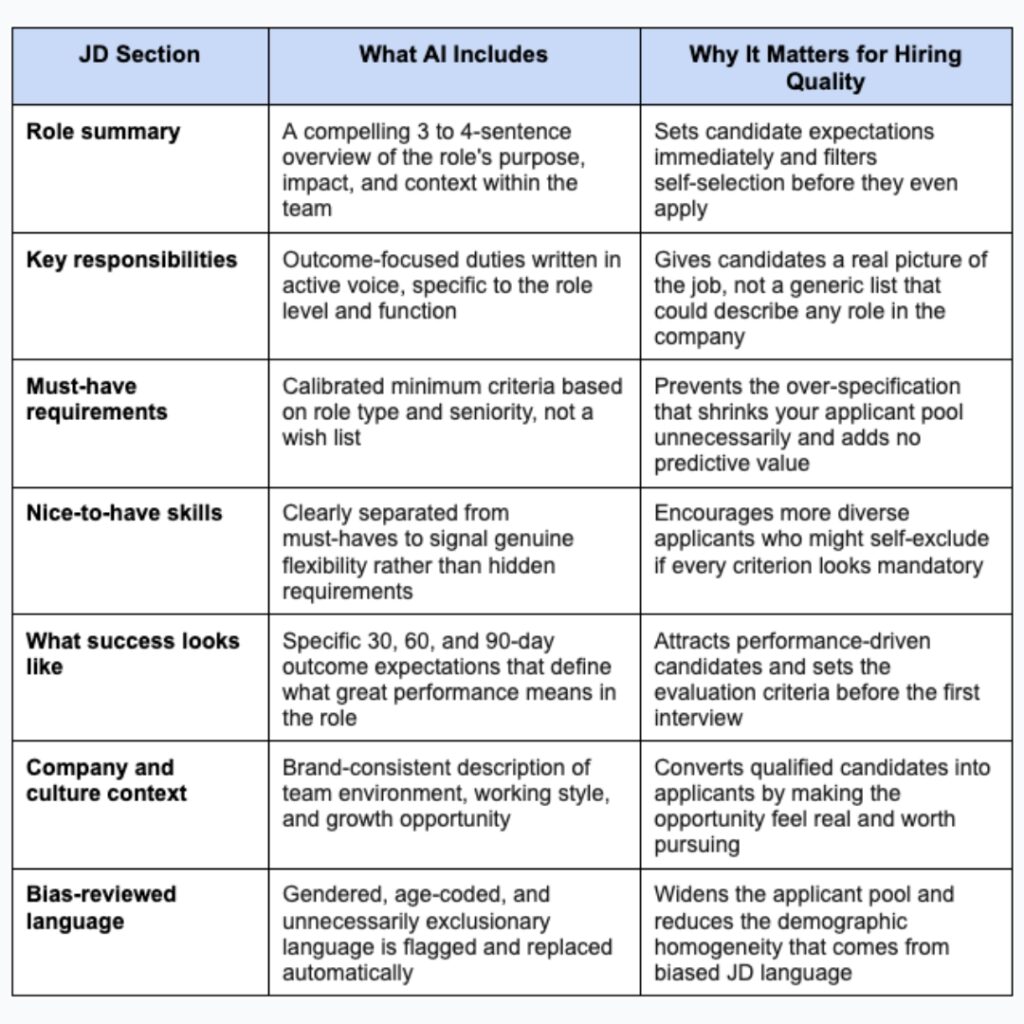
Manual vs AI-generated job descriptions: The full comparison
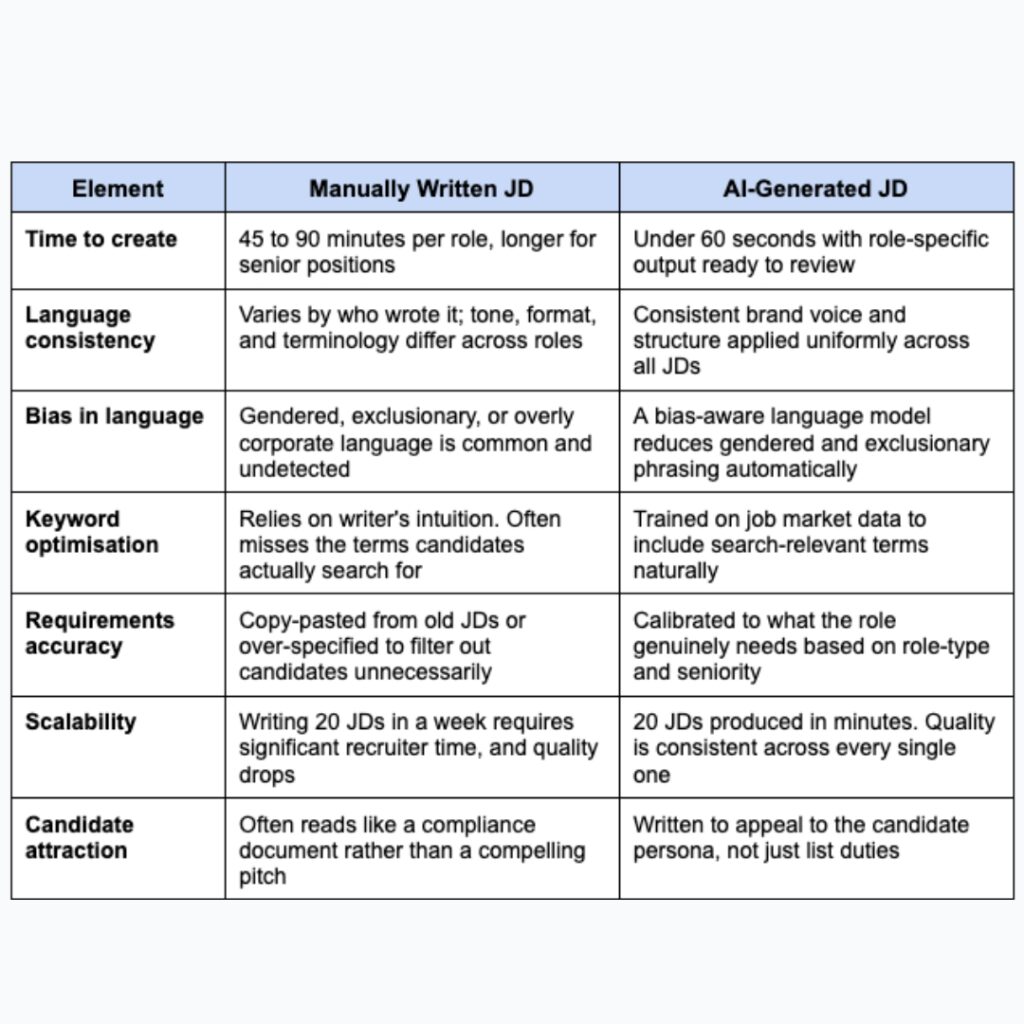
Time and quality data: SHRM Recruiting Benchmarks 2024, LinkedIn Talent Solutions 2025, Textio Inclusive Language Research 2024, and Indeed Hiring Lab 2025.
How better job descriptions connect to better hiring outcomes?
The improvement in job description quality is not just about saving recruiter time, though that benefit is real and significant. The deeper impact is on the quality and composition of your applicant pipeline, which flows directly into every downstream hiring decision.
Higher-quality applications from the start
When a job description clearly communicates what the role actually requires, what success looks like, and what the opportunity genuinely offers, the candidates who apply are the ones who read it carefully and think, ‘Yes, this is for me.’ That self-selection process is the most efficient filter in your entire hiring funnel, and it only works if the description gives candidates enough real information to make an accurate judgment.
Better AI interview alignment
This is where the connection to easemyhiring.ai becomes particularly powerful. When an AI generates your job description, it captures the specific competencies and requirements of the role with a precision that a manually written JD rarely achieves. Those same role-specific parameters can then inform the structured AI interview questions that easemyhiring.ai builds for the first-round screening.
The result is a pipeline where the job description, the screening criteria, and the interview questions are all calibrated to the same definition of what a great hire looks like for that specific role. Every part of the process pulls in the same direction, which is the foundation of consistently high-quality hires.
Reduced time-to-fill through better pipeline quality
When fewer unqualified candidates apply, and more genuinely strong ones do, the screening workload decreases, the shortlisting process speeds up, and the final hiring decision is made more easily and quickly with confidence. The improved JD at the top of the funnel compresses time-to-fill throughout the entire pipeline, not just at the application stage.
More consistent employer brand expression
When every job description across your organisation is generated with the same brand voice, inclusive language standards, and structural consistency, your careers page and job listings start to feel like a coherent talent attraction platform rather than a patchwork of however different people happened to write on different days.
For growing companies doing multiple hires simultaneously, this consistency is a meaningful employer brand signal to candidates who are researching you before they decide whether to apply.
What this means for startup founders and HR teams?
If you are a startup founder trying to hire your first ten people without a dedicated HR team, AI job description generation removes one of the most time-consuming and error-prone parts of the process. You are not a professional job description writer. You should not have to be. The AI produces a strong first draft in seconds; you review and adjust for anything that is specific to your company, and it is ready to post.
If you are an HR leader managing multiple open roles simultaneously, the time saved is significant. Forty-two minutes per JD adds up fast when you have twelve open positions. With AI generation, that time drops to under five minutes per role, including your review. Your team gets that time back for the work that actually requires their judgement.
If you are running high-volume or campus hiring, the consistency benefit is arguably even more valuable than the speed. When every JD follows the same structure, uses the same inclusive language standards, and is calibrated to actual role requirements rather than aspirational wish lists, your applicant pool is larger, more diverse, and better self-selected before you screen a single application.
The bottom line
A job description is not a box-ticking exercise at the start of your hiring process. It is the first conversation you have with every candidate who will ever consider working for you. The quality of that conversation determines whether the right people apply, whether the wrong people self-select out, and whether the candidates who do engage with your process feel like this company knows what it wants and is worth their time.
AI job description generation changes what that conversation looks like. Faster, more consistent, bias-aware, keyword-optimised, and written to attract the candidates you actually want rather than simply describe the duties you need covered.
When that better job description feeds into a structured AI interview process like easemyhiring.ai, the two work together to create a hiring pipeline where every stage from first impression to first interview is calibrated to the same definition of a great hire.
That is not a small efficiency gain. That is a fundamental upgrade to how your hiring works from the very beginning.
Your job description is your best recruiter. Is it doing its job?
If your job descriptions are still being written from memory, copied from old templates, or posted without a bias review, you are starting your hiring process behind. easemyhiring.ai connects AI-powered job description generation directly to structured, consistent, bias-free first-round interviews so your pipeline is stronger from the first word to the final offer.
- AI-generated job descriptions in seconds. Structured, compelling, bias-reviewed, and keyword-optimised for every role you open.
- Consistent language and format across every JD your team posts. No more patchwork careers pages that reflect whoever happened to write each listing.
- Better applicant self-selection from day one. When the JD is accurate and compelling, the right candidates apply, and the wrong ones move on.
- Seamless connection from JD to AI interview. The same role-specific criteria that shape your job description inform the structured interview questions every candidate receives.
- Zero admin, instant performance reports, and bias-free evaluation throughout. Easemyhiring.ai handles the full first-round pipeline so your team focuses on final decisions.
Book your free consultation at easemyhiring.ai and start your next hire with a job description that actually works.
Every great hire starts with the right first impression. Make sure yours is working for you, not against you.