
It is one of the most debated questions in modern hiring. Can an AI really spot a great candidate better than an experienced human interviewer? Or is this just technology for technology’s sake?
The honest answer is more nuanced than most people expect. AI and human interviewers each bring genuine strengths to the table. But the data also shows some uncomfortable truths about where human-only interviews consistently fall short and where AI fills those gaps in ways that directly improve the quality of hire.
This is not a debate about replacing humans. It is a conversation about building a process that combines the best of both. Let us look at the evidence.
The case for human interviewers
Let us start where most hiring teams are already comfortable. Human interviewers bring things to the table that no AI can fully replicate, at least not yet.
Emotional intelligence and genuine rapport
A skilled human interviewer can read the room. They notice when a candidate seems nervous but clearly competent. They can put someone at ease, adapt their tone, and create a conversation that brings out a candidate’s best side. This emotional intelligence matters, especially for senior roles where cultural alignment and interpersonal dynamics are central to success.
Deep, context-aware follow-up questions
When a candidate gives an unexpected but interesting answer, a great human interviewer knows how to follow that thread. They ask the unscripted question. They dig into the nuance. This kind of adaptive, contextual probing can surface insights that a fixed interview script would never reach.
Representing your company culture
The interview is not just a screening exercise. It is also a brand experience for the candidate. A compelling human interviewer can sell the role, communicate company values authentically, and make a great candidate feel genuinely wanted. This matters more than most companies realise, especially when competing for top talent in a tight market.
A great human interviewer is irreplaceable at the relationship and culture layer of hiring. The data just shows they need better tools to be consistent at the evaluation layer.
"The case for AI interviewers
Now, let us look at where the data gets uncomfortable for human-only processes.
Consistency is not optional but humans struggle with it
Studies on interviewer reliability consistently show that unstructured human interviews have surprisingly low predictive validity for job performance. The reason is simple: two interviewers assessing the same candidate often reach different conclusions based on factors that have nothing to do with the candidate’s ability.
Time of day affects judgement. Back-to-back interviews cause fatigue. The candidate who follows an exceptional interview gets marked down by comparison. These are not character flaws. They are features of human cognition that no amount of training fully eliminates.
AI does not have these problems. When easemyhiring.ai runs a structured interview, candidate number one and candidate number one hundred receive exactly the same experience, evaluated on exactly the same criteria. No fatigue. No comparison bias. No drift.
- 38% of hiring decisions are influenced by irrelevant factors like likeability and appearance. (Harvard Business Review)
- 2x higher predictive validity for structured vs unstructured interviews. (Schmidt & Hunter, Journal of Applied Psychology)
- 67% of hiring managers admit to making a decision within the first five minutes of an interview. (CareerBuilder)
Unconscious bias is a documented problem, not a hypothesis
The research on unconscious bias in hiring is extensive and consistent. Identical CVs with different names attached receive different callback rates. Candidates from certain educational backgrounds are systematically favoured regardless of performance. Interview assessments are influenced by gender, accent, and physical appearance in ways that assessors themselves are unaware of.
AI is not immune to bias, particularly if trained on biased historical data. But when properly designed and audited, AI interviewing systems like easemyhiring.ai evaluate candidates purely on the content and quality of their responses, not on extraneous factors. This is a meaningful, measurable improvement over unstructured human screening.
Speed and scale that humans simply cannot match
A human recruiter can conduct a limited number of quality interviews per day before performance degrades. For companies doing bulk hiring or managing high application volumes, this creates a fundamental bottleneck.
AI has no such constraint. easemyhiring.ai can run hundreds of structured interviews simultaneously, each one generating an instant performance report. What would take a human team three weeks takes hours. And quality does not drop at volume because there is no fatigue, no rushing, and no shortcuts taken on the hundred and fiftieth candidate.
Instant, objective reports replace subjective recall
Ask a human interviewer to recall the details of their sixth interview of the day with precision and you will get a reconstructed memory shaped by everything that happened since. Ask easemyhiring.ai and you get a timestamped, structured performance report generated the moment the interview ended.
This shift from subjective recall to objective data does not just save time. It directly improves hiring decisions by giving managers a consistent, comparable view of every candidate in the pipeline.
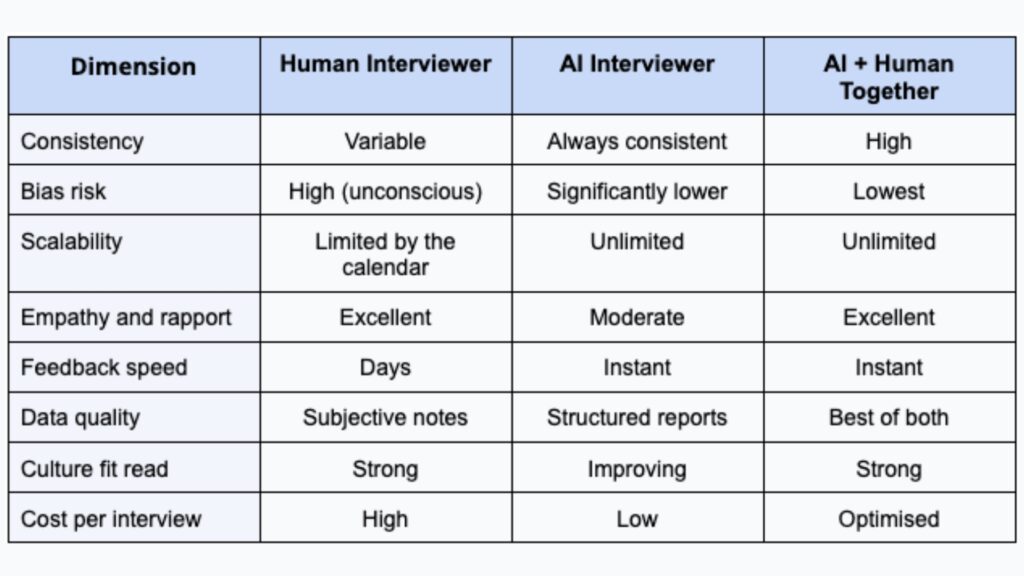
Head-to-head: the data-backed comparison
Here is how AI and human interviewers compare across the dimensions that matter most to hiring quality.
The real answer: AI and humans working together
The smartest hiring teams in 2026 are not choosing between AI and human interviewers. They are using each where it performs best.
Let AI own the first round
First-round screening is where bias, inconsistency, and wasted time are most concentrated. It is also where the stakes of an individual judgment call are lowest. This is the perfect layer for AI to take over.
With easemyhiring.ai handling structured first-round interviews, every applicant gets fairly assessed before a human ever gets involved. Recruiters receive a ranked, reported shortlist and can focus their time and energy on the candidates who have already demonstrated the baseline competencies for the role.
Let humans own the final rounds
Final interviews are where human judgment matters most. Can this person lead a team through ambiguity? Do their values align with where the company is going? Will they thrive in this specific team’s dynamic? These are questions that benefit from human engagement, conversation, and instinct.
When AI has already filtered the pipeline to a shortlist of genuinely qualified candidates, human interviewers can focus entirely on these deeper questions rather than spending 80 percent of their interview time establishing basic competency.
Better data makes human decisions smarter
When a hiring manager walks into a final interview having already reviewed an objective performance report from easemyhiring.ai, they are a better interviewer. They know which areas to probe. They understand where the candidate showed strength and where gaps might exist. The human conversation is richer and more targeted because the AI has already done the groundwork.
AI does not replace the human judgment at the heart of great hiring. It gives that judgment better data, more time, and a cleaner pipeline to work with.
"What does this mean for your hiring team?
Whether you are a startup founder building your first team, a hiring manager juggling ten open roles, or an HR leader running high-volume recruitment drives, the implication is the same.
A process that relies entirely on human interviewers at every stage is leaving bias, inconsistency, and wasted time on the table. A process that removes humans entirely misses the relationship and cultural intelligence that great hiring requires.
The teams winning the talent competition in 2026 are the ones who have figured out how to deploy both, strategically, with AI handling the scale and consistency layer, and humans owning the culture and judgment layer.
That is the model easemyhiring.ai is built to enable.
The bottom line
AI does not spot better candidates than humans in every dimension. But it spots them more consistently, more fairly, and at a scale that no human team can match.
Humans bring empathy, cultural intelligence, and contextual depth that AI is still developing. But they also bring bias, fatigue, inconsistency, and time constraints that quietly undermine hiring quality every day.
The question is not who is better. The question is how you build a process that uses each one where they actually excel. That is what the data points to. And that is what the best hiring teams are doing right now.
Give your hiring team the best of both worlds.
If your current process relies entirely on human interviewers with no structured framework, no consistent criteria, and no objective data, you are making hiring decisions harder than they need to be. Here is what changes when you bring easemyhiring.ai into your process:
- Structured, bias-free AI interviews for every first-round candidate. Consistent criteria. No fatigue. No variance.
- Instant performance reports so hiring managers walk into finals with real data. Not impressions. Not notes. Objective scoring.
- Unlimited interview capacity for bulk hiring or high-volume recruitment. Scale without sacrificing quality.
- Zero admin. No scheduling back-and-forth, no chasing candidates, no manual follow-up. Your recruiters focus on people, not logistics.
- Human judgment where it matters most. AI handles the screening. Your team owns the final decision.
Get your free trial at easemyhiring.ai and build a hiring process that is smarter, faster, and fairer.
The best hiring decisions come with the best data. Give your team the tools to make them.
"